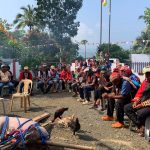








BFAR conducts ceremonial turnover of three million tilapia fingerlings to local fish growers of Bukidnon on April 15, 2026. (Contributed to BukidnonNews.Net by Mel B. Madera)
MALAYBALAY CITY (BukidnonNews.Net/ 15 April 2026) — Despite having nearly 3,000 fishponds, Bukidnon still outsources tilapia from other regions, pointing to strong unmet local demand that the Bureau of Fisheries and Aquatic Resources (BFAR) says could drive industry expansion.
“Much of the tilapia sold in Bukidnon markets still come from other regions because our backyard production is quickly absorbed locally. This signals strong potential for expanding commercial production and strengthening the province’s market, especially given its abundant water resources,” said Gekie S. Sy, officer-in-charge of BFAR’s Provincial Fisheries Office.
BFAR and local stakeholders moved to address this gap during the 2nd Tilapia Festival on April 15 at the Centennial Backstage, Kaamulan Park, where organizers distributed three million tilapia fingerlings to fish growers from all 22 local government units.
The Kisolon Freshwater Fish Production and Regional Training Center in Sumilao supplied the fingerlings, strengthening local aquaculture capacity and reducing dependence on external sources.
Local government units reported to the Philippine Statistics Authority that Bukidnon has 2,964 fishponds. Yet most operators still run small-scale or backyard aquafarms, limiting overall output.
“Compared with other provinces in Region 10, we may have a large number of fishponds, but many are still small and have yet to transition into commercial and intensive production systems,” Sy said.
BFAR estimates that a one-hectare fishpond, operating on a four- to five-month production cycle, can generate a projected net income of ₱672,250—underscoring tilapia’s viability as both a livelihood and an investment.
Tilapia remains the leading commodity in Bukidnon’s fisheries sector, with production reaching 451 metric tons in 2025, based on PSA data.
BFAR Regional Director Edward B. Yasay said the post-harvest symposium held alongside the festival will enhance skills and help scale up tilapia production initiatives. He also expressed optimism that tilapia farming can become a stronger livelihood source, especially amid growing demand.
At the provincial level, Ma. Lilith M. Turan urged farmers with reliable water sources to venture into tilapia farming as an additional income stream.
“We should prioritize selling our fish within our communities so we can continue providing accessible food,” Turan said, noting that rising fuel costs have reduced the presence of fish, chicken, and egg vendors in barangays.
She added that the province has organized a task force to strengthen the Kadiwa ng Pangulo in every city and town, while encouraging fish growers to market their harvest alongside affordable rice in Kadiwa centers.
Representing Governor Rogelio Neil P. Roque, Assistant Provincial Administrator Mercy Ebcas reaffirmed the provincial government’s support for programs that uplift tilapia growers and expand production.
Producers are also transforming tilapia into value-added products such as siomai, longanisa, dried tilapia, and TilaPeanutMix, opening new opportunities across the value chain.
Carrying the theme “Tilapia in Bukidnon: From Pond to Plate, Advancing Together,” the festival brought together fish growers, Indigenous Peoples, youth, local governments, and other stakeholders to promote best practices, innovation, and collaboration aimed at improving efficiency and productivity in the aquaculture sector. (Text and photo contributed to BukidnonNews.Net by Mel B. Madera)